#04
Combinatorial High-throughput Analysis & Optimization for Synthesis
A federated, provenance-preserving database of high-throughput DFT computations — queryable in AFLUX or natural language — feeding GNN models for materials discovery.
- Field
- Database Engineering
- Year
- 2024
- Role
- Lead Engineer
- Built with
- C++ · SQLite · AFLUX · RAG
CHAOS — Combinatorial High-throughput Analysis & Optimization for Synthesis — is a federated database for searching the enormous combinatorial space of inorganic materials. With 200+ queryable elements across more than 200,000 publicly available DFT computations, the space of possible queries is vast; CHAOS makes it searchable without forcing any contributor to surrender their data.
That federation is the core design choice. Rather than pooling everything into one central store, each institution keeps and serves its own database. Data stays owned, can be retracted if needed, and remains traceable for proper attribution — and a researcher can search across the whole network at once or scope a query to a single source.
Under the hood CHAOS is forked from AFLOW and speaks its AFLUX query language, inheriting a mature, well-specified interface to high-throughput materials data. The system is written in C++ for the heavy compute and high-volume ingestion the pipeline demands, with SQLite as the per-node store — lightweight enough to deploy identically across every database in the federation.
CHAOS is the front of a discovery pipeline, not the end of it. Its computations feed a graph neural network that predicts formation energy and magnetic moments for High-Entropy Oxides, generating candidate lattice-structure predictions for synthesis.
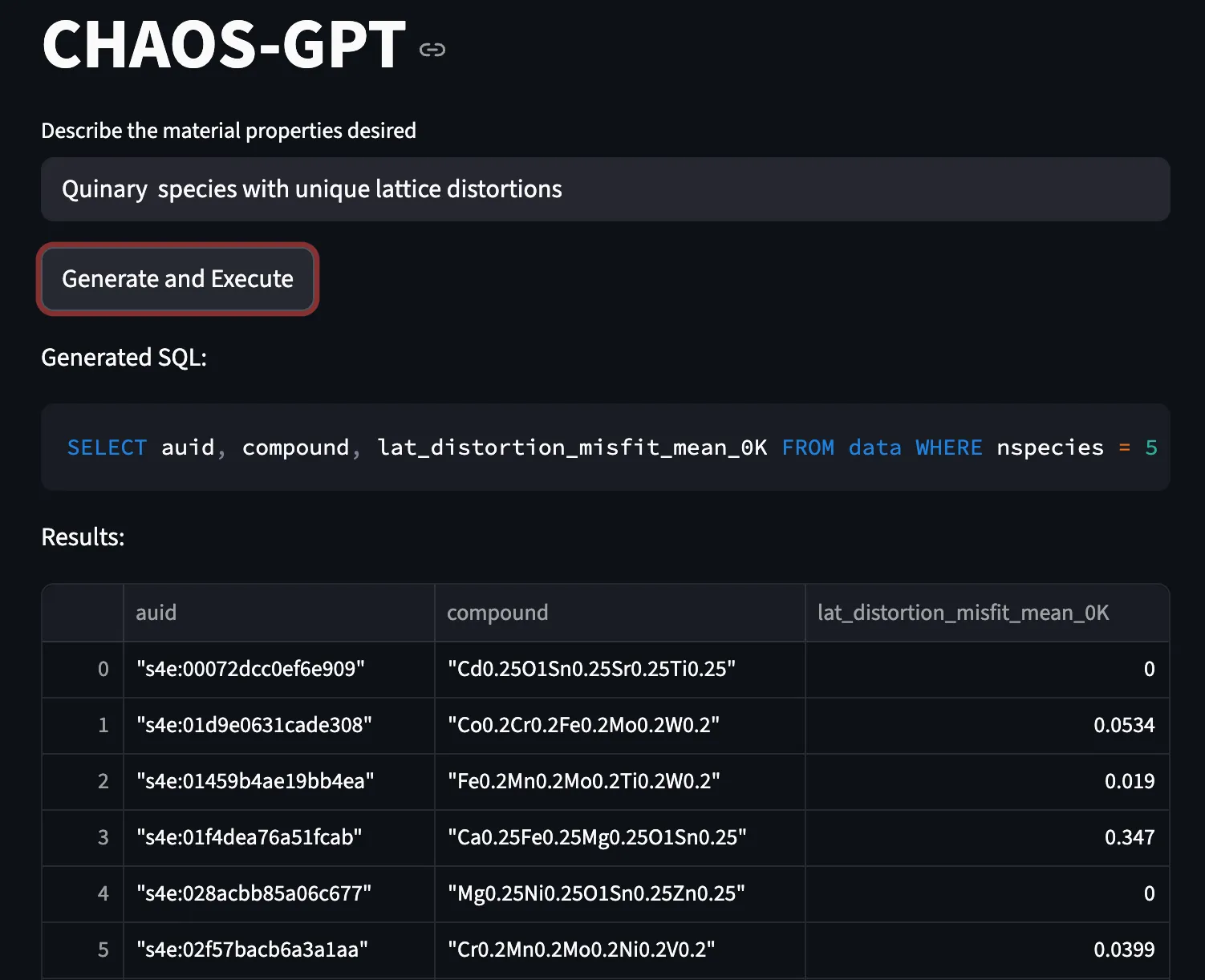
CHAOSGPT is a second way in. Instead of writing AFLUX, a researcher can ask in plain language; a RAG layer interprets the question, narrows it to the relevant queryable elements, and issues a tighter, more efficient search against the database. It currently runs on Gemini-Flash-2.5 via OpenRouter, with a path toward locally hosting a comparable open model (Qwen or Llama) for full self-sufficiency.
The system is online — browsable at the link above and accessible programmatically through the web API — with the paper currently in preprint. As lead engineer I built the C++ core, manage the web interface, and implemented the CHAOSGPT RAG system.
To use CHAOS visit: s4e.ai